Not Quite Red, Not Quite Black: The Mystery of the Cross Fox

On the beautiful tundra margins south of Hudson Bay, where boreal forest thins into open subarctic scrub, an extraordinary animal stepped out of the willows and paused — long enough to leave the observer speechless. Not a wolf, not a coyote, but a fox unlike most people have ever seen: dark, dramatic, and branded across its back with what appears to be a natural cross drawn in black fur. This is the cross fox, and Churchill, Manitoba, is one of the finest places on earth to find one.
What makes this encounter doubly remarkable is that two individuals were photographed at different locations in the same area — a reminder that this is no statistical oddity, but a genuine, flourishing colour morph in Canada’s northern fox population.
Not a separate species — a colour morph

A cross fox photographed near Churchill, Manitoba. The signature dark dorsal stripe and shoulder bar are clearly visible against the reddish base coat. Photo: Niroshan Mirando · Churchill, Manitoba
For centuries, naturalists believed the cross fox was a distinct species, even assigning it the binomial name Canis decussatus. Modern genetics has answered the question definitively: the cross fox is simply the red fox, Vulpes vulpes, wearing a different coat of genes. It belongs to the same species, the same genus, and shares virtually every biological trait with its red-coated relatives. What differs is a matter of melanin.
The cross morph is believed to result from interactions between pigmentation genes such as MC1R and ASIP, which regulate the balance between dark and reddish pigments. The result is something intermediate: darker and more dramatic than a typical red fox, but not the near-black of the silver morph.
In some parts of Canada, cross foxes can make up a significant portion of the population — in certain regions, estimates approach 30%.
A red fox, photographed at a different location in the Churchill area. Photo: Niroshan Mirando · Churchill, Manitoba

How to identify a cross fox
The defining feature is a dark dorsal stripe running from the back of the neck to the base of the tail, intersected by a second stripe across the shoulders — forming an unmistakable cross. The base coat is reddish-brown, and the flanks and sides of the neck retain that warm russet tone. The lower legs are black, as in typical red foxes, and the tail is full and bushy, often with a white tip — that white tail tip being a key field mark distinguishing all red fox morphs from other canid species.
Some individuals develop a dark or silvery facial mask, further enhancing their striking appearance. While not formally classified, cross foxes are sometimes described as “standard,” “gold,” or “silver” forms, reflecting differences in tone and contrast. No two individuals are exactly alike — a detail that makes photographing multiple animals particularly compelling, as the Churchill sightings so clearly illustrate.
Cross fox vs. red fox: the key differences

A red fox, photographed at a different location in the Churchill area. Photo: Niroshan Mirando · Churchill, Manitoba

The second individual, photographed at a different location in the Churchill area. Note the variation in dark patterning compared to the first animal — each cross fox is unique. Photo: Niroshan Mirando · Churchill, Manitoba
Both are Vulpes vulpes, so the similarities vastly outweigh the differences. But for the field observer, here is what sets them apart at a glance:
Cross fox
Typical red fox
In terms of size, behaviour, diet, and ecology, the two are identical. Both weigh between 3 and 14 kg, measure 45–90 cm in body length, and share the same opportunistic, omnivorous lifestyle. Both are crepuscular to nocturnal hunters, using that famously acute sense of hearing — and, in a remarkable piece of biology, some studies suggest they may use Earth’s magnetic field—to locate prey beneath snow.
Species profile: Vulpes vulpes

A cross fox photographed near Churchill, Manitoba. Photo: Niroshan Mirando · Churchill, Manitoba

A cross fox photographed near Churchill, Manitoba. Photo: Niroshan Mirando · Churchill, Manitoba
The red fox (Vulpes vulpes), in all its colour forms, is one of the most widely distributed wild carnivores on the planet. Its range spans North America, Europe, Asia, and northern Africa, with introduced populations established in Australia. It thrives from sea level to elevations above 4,500 metres, adapting to boreal forest, tundra, prairie, farmland, and even urban environments.
- 45+ subspecies of V. vulpes
- ~14 kg maximum body weight
- ~30% of Canadian red foxes are cross morphs
Diet: Red foxes are consummate opportunists — small mammals (especially voles and hares), birds, insects, berries, carrion, and cached food stores. They scatter-hoard surplus prey in dozens of small caches, revisiting them during lean periods. This behaviour is particularly valuable in Churchill’s boreal-subarctic environment, where seasonal food availability is highly variable.
Reproduction: Mating occurs from January to March. Gestation averages 52 days, with litters typically of 4–5 kits (occasionally up to 12). Pairs are generally monogamous within a season, though males sometimes mate with multiple females. Kits are born blind and fully dependent, reaching independence by autumn.
Social structure: Foxes are largely solitary outside the breeding season. Home ranges are held by an adult male and one or two females, with pathways connecting den sites, hunting grounds, and food caches. The same den is often used across multiple generations.
Conservation status

The red fox — including all its colour morphs — carries the IUCN conservation status of Least Concern, a reflection of its enormous range and extraordinary adaptability. No specialist conservation measures are required at the species level.
Historically, cross fox pelts were among the most prized in the North American fur trade, valued for their unusual dark patterning. Intensive trapping in the late 19th and early 20th centuries significantly reduced cross fox numbers in some regions, particularly the western United States. In Canada, where the morph remains common, populations are considered stable.
Why Churchill?

A red fox, photographed at a different location in the Churchill area. Photo: Niroshan Mirando · Churchill, Manitoba
Churchill sits at the intersection of three biomes — boreal forest, Hudson Bay lowlands, and open tundra — creating a mosaic of edge habitats that suits the red fox perfectly. The town is globally famous for polar bears and beluga whales, but for the attentive wildlife photographer, the subarctic scrub around Churchill offers something equally compelling: a healthy, accessible population of red foxes in which the cross morph appears with notable frequency.
Two individuals at separate locations in a single visit is an exceptional outcome — and a testament to both the health of the local fox population and the quality of the habitat Churchill’s unique landscape provides.
References
Animals Discovered. (2026, January 3). Cross fox facts: The masked trickster of the north. https://animalsdiscovered.com/animals/cross-fox/
A-Z Animals. (2024, May 27). Cross fox animal facts: Vulpes vulpes. https://a-z-animals.com/animals/cross-fox/
A-Z Animals. (2024, May 27). Red fox animal facts: Vulpes vulpes. https://a-z-animals.com/animals/red-fox/
Fox, D. (2007). Vulpes vulpes [Animal profile]. Animal Diversity Web, University of Michigan Museum of Zoology. https://animaldiversity.org/accounts/Vulpes_vulpes/
Grokipedia. (2026, January 17). Cross fox. https://grokipedia.com/page/Cross_fox
Learn About Nature. (2023, August 21). What is a cross fox? Characteristics & interesting facts you should know. https://www.learnaboutnature.com/mammals/fox/what-is-a-cross-fox/
MacDonald, D., & Reynolds, J. (2005). Red fox (Vulpes vulpes). IUCN Canid Specialist Group. http://www.canids.org/species/Vulpes_vulpes.htm
Wikipedia contributors. (2026). Vulpes. Wikipedia, The Free Encyclopedia. https://en.wikipedia.org/wiki/Vulpes
The Ghost Ship on Hudson Bay

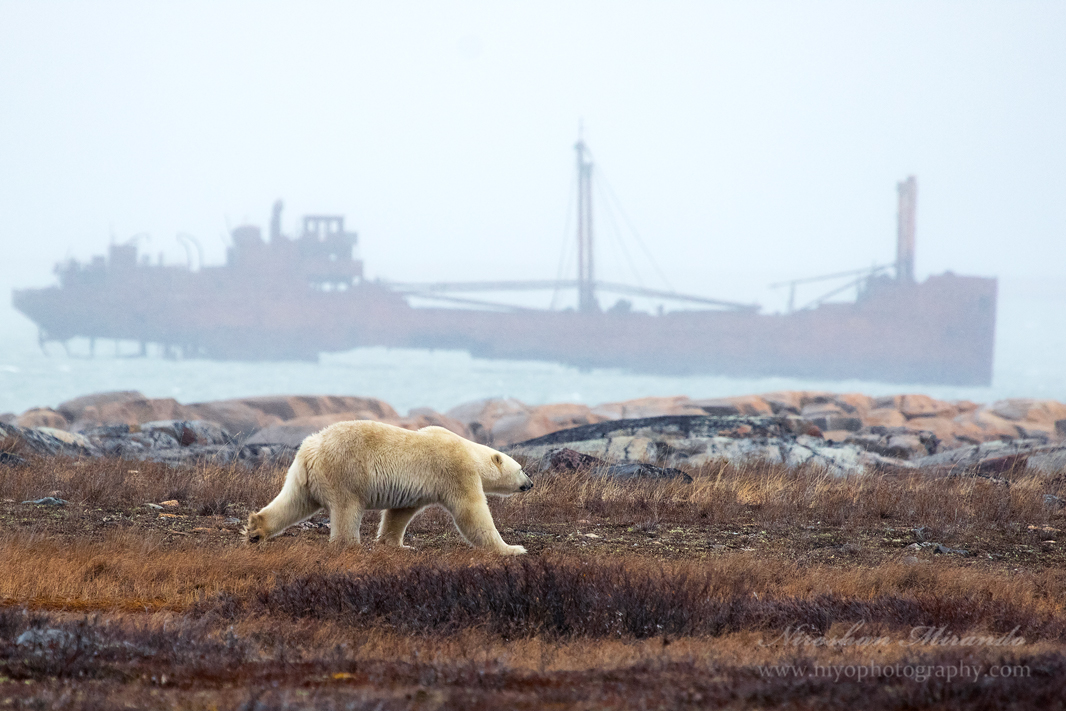
So I’ve been sitting on this photo for a while, trying to find the right words. There’s this rusting old wreck half-sunken in the shallows just east of Churchill, Manitoba — the SS Ithaka — and honestly, it stopped me in my tracks the moment I saw it.
The ship has lived many lives. She was built back in 1922 in Trois-Rivières, Quebec, and launched as the Frank A. Augsbury for a Canadian coal and shipping company. Over nearly four decades she changed hands and names six times — Granby, Parita II, Valbruna, Lawrencecliffe Hall, Federal Explorer — each name a new chapter, a new owner, a new ocean. During the Second World War she was taken over by Britain’s Ministry of War Transport, and in 1945, she collided with another vessel off the English coast, was holed aft, and had to be towed to the River Blackwater to be laid up for repairs. She bounced between Panamanian, Italian, and Canadian owners before ending up as Federal Explorer, hauling fuel oil to Arctic air force stations and nickel ore to remote northern communities — a workhorse of the Canadian north.

Polar bear
In 1960, she was sold one final time — to a Greek owner named J. Glikis, registered in Nassau, Bahamas — and rechristened Ithaka. Her last voyage was a short one. She sailed out of Churchill on September 10, 1960, heading to Rankin Inlet to collect nickel concentrate, but was caught in a severe gale. She lost her rudder, dropped anchor, the anchor chain snapped, and she was driven helplessly onto a gravel bank in Bird Cove — about 12 kilometres east of Churchill — on September 14th. Winds were howling at 80 miles per hour, and the pounding storm ripped her bottom completely out. Lloyd’s of London declared her a total loss — and suspiciously, refused to pay the insurance claim. All 37 crew members were rescued by the Canadian Coast Guard and landed safely in Winnipeg.

Polar bear
She’s been sitting there ever since. Rusting. Slowly becoming part of the landscape.
And that’s where the moment happened that I still can’t fully explain.
I was out on the shore, camera in hand, taking in this massive steel ghost — when a polar bear materialized out of nowhere and wandered right into my frame. Just there, between me and the wreck, like he owned the whole coastline. Which, honestly, he did. The tundra, the tide, the broken hull — all his. I held my breath and pressed the shutter and stood very, very still. That one frame — rust and iron and ice-white fur against the grey of Hudson Bay — felt like something the world had arranged just to remind me how small and lucky I am.
Churchill does that to you. It hands you moments you didn’t earn and couldn’t have planned. That polar bear in front of a century-old wreck is mine to keep forever.
Cycle of Destruction and Renewal: Black-Backed Woodpecker Encounter in Whiteshell Provincial Park


Woodpecker with larvae (click to enlarge)
Earlier this summer, I was heartbroken as one of my favorite places in Canada, Jasper Town and Jasper National Park suffered devastating forest fires that destroyed a significant part of the town and some of the most beautiful, forested areas, all set against stunning mountain backdrops. Have you ever wondered how wildlife thrives after the devastation of forest fires? Burnt forests become sanctuaries for certain species, among them is the wood-boring beetles, which thrive underneath the burnt trees. These beetles are a crucial player in the forest’s regeneration. As this process continues another species thrives on and attains the full benefits, this is none other than the black-backed woodpecker, a bird that specializes in feeding on wood-boring beetles.
Read More»Lone Grey Wolf: A Journey of Dispersal and Survival

Last October, I traveled to Churchill, Manitoba with friends and family, eager to see the famous polar bears that gather there and migrate each October. Known as the “polar bear capital of the world,” it seemed the perfect time for sightings. While I had many memorable moments from that trip, one encounter caught me completely off guard: I found myself face-to-face with a lone grey wolf. It wasn’t what I had expected, but it opened my eyes to the incredible journey these animals undergo during dispersal.
Read More»World’s Largest Snake Gathering: Discover Manitoba’s Narcisse Snake Dens

C
an you imagine that just 110 kilometers from Winnipeg, the lively capital of Manitoba with a population of just over 800,000, lies one of the world’s most incredible wildlife spectacles? Each spring, tens of thousands of red-sided garter snakes emerge from their limestone dens, shaking off the long grip of the harsh Canadian winter. These snakes slither in overwhelming numbers, driven by a primal instinct to mate before disappearing into their summer habitats. The sight of them coiling and writhing in the sun is nothing short of breathtaking, drawing in both curious tourists and dedicated wildlife researchers from around the globe. Witnessing so many snakes in one place is truly mesmerizing and an unforgettable experience for anyone brave and lucky enough to see it.
Read More»Crested Hawk Eagle and a Lesser Whistling Duck Encounter at Wilpattu National Park, Sri Lanka.

During the time I lived in Sri Lanka and during my regular visits to Sri Lanka, Wilpattu National Park didn’t disappoint me with unforgettable wildlife sightings and unforgettable experiences. This is where my passion for wildlife photography grew into great proportions. This is a story I wanted to tell for a while and finally got some spare time to blog about this extraordinary experience I had with a Crested Hawk Eagle Back in 2016, on a cold and foggy morning on one of my visits to the Wilpattu National Park.
Read More»The Season of Western Tiger Salamander

As I scroll through my image archives something interesting came to my mind because of a photoshoot I did a few years ago. I quickly glanced at my calendar; I realized that it was almost mid-August. An interesting phenomenon happens in my favorite National park close to Winnipeg at this time of the year.
Riding Mountain National Park is known for its rich biodiversity, as we keep an eye on big animals like Black Bears, Moose, Lynx, Foxes, and wolves, on a rainy cool evening after mid-August, an explosion of Western Tiger Salamander happens. I reckon this to the largest animal gathering in Manitoba next to the red-sided garter snakes gathering in Narcisse snake dens in Manitoba. I am a careful driver, I will avoid driving over salamanders at all costs as they slowly march out of their ponds around Highway 10, Lake Audy Road, and side roads in and around Erickson, Manitoba, These Locations come from my observation during the last five years and western tiger salamanders can be found all around the national park and close by towns.
Read More»Why Riding Mountain National Park Is The Best Place To Observe Moose In Their Natural Habitat In Manitoba, Canada.

The more I travel in Riding Mountain National Park Manitoba, Canada the more I get obsessed with this amazing National park, I started visiting the Park mainly targeting the American black bears, especially in spring because it’s one of the best places to see bear cubs in Manitoba. While targeting bear photo shoots I stumbled upon an opportunity to observe moose and amazed me how abundant the moose’s activity is in the area.
Read More»Face To Face With Greater Flamingos In Mannar Island, Sri Lanka


My First flamingo encounter, Mannar 2013
I had this fantasy for a long time to take some good pictures of flamingos because I had always been fascinated with pictures taken in Africa and by some of my fellow Sri Lankan photographers. Back in January 2013, I had my first stroke of luck with these elusive birds at the Mannar slattern. However the sighting was under extremely harsh lighting and at a very long distance, so I had to be content with a few record shots. However last year around March, I had a better encounter with these amazing birds at the Bundala Lagoon in Bundala National Park, Sri Lanka. The sighting was good but approaching them was nearly impossible, as they were far from the lagoon. As Bundala was a national park the rules did not permit me to approach them by foot or to get closer. Again, I had to settle for some long-range shots.
Read More»Close Encounter With A Group Of Ruddy Turnstone
- At February 25, 2014
- By Niroshan Mirando
- In Species Watch
 0
0

I was fascinated about the abundant bird life presented in Mannar Island during past few months and some friends started to question me whether I live there. Reason for that is no surprise as I have made about 5 trips within the past 3 months period and every time I went ended up staying more than 3 days due to the fact that internet connection there works superbly (3 G), This has enabled me to do 2 hours of birding each morning and evening while doing my regular work in-between.
Read More»