The Ghost Ship on Hudson Bay


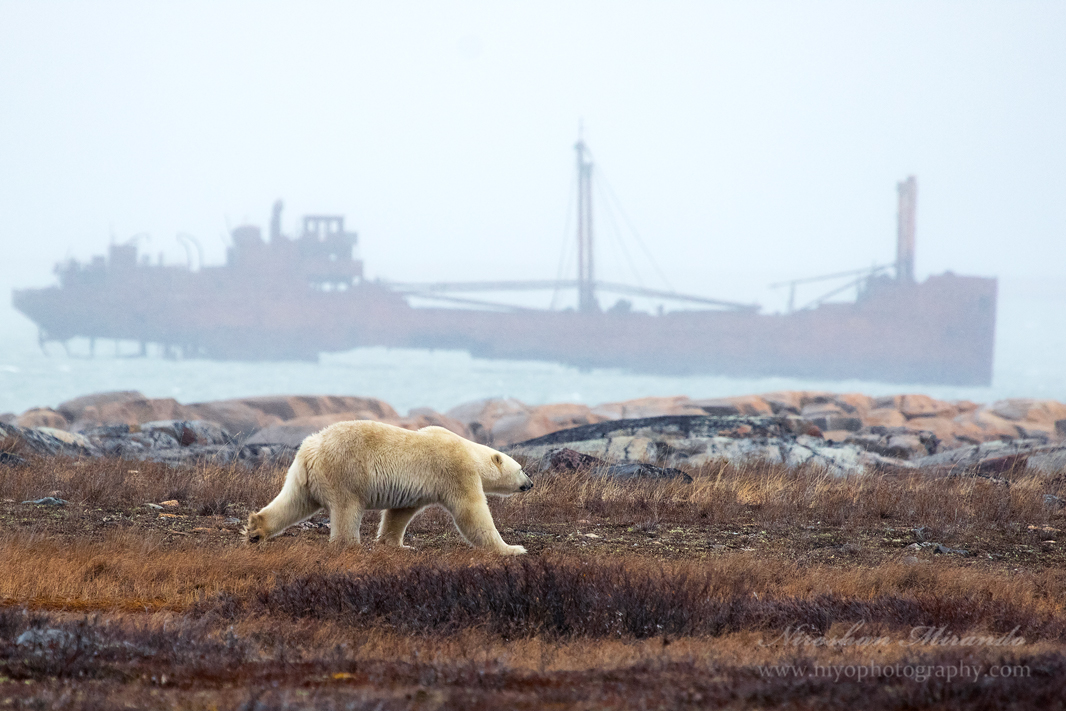
So I’ve been sitting on this photo for a while, trying to find the right words. There’s this rusting old wreck half-sunken in the shallows just east of Churchill, Manitoba — the SS Ithaka — and honestly, it stopped me in my tracks the moment I saw it.
The ship has lived many lives. She was built back in 1922 in Trois-Rivières, Quebec, and launched as the Frank A. Augsbury for a Canadian coal and shipping company. Over nearly four decades she changed hands and names six times — Granby, Parita II, Valbruna, Lawrencecliffe Hall, Federal Explorer — each name a new chapter, a new owner, a new ocean. During the Second World War she was taken over by Britain’s Ministry of War Transport, and in 1945, she collided with another vessel off the English coast, was holed aft, and had to be towed to the River Blackwater to be laid up for repairs. She bounced between Panamanian, Italian, and Canadian owners before ending up as Federal Explorer, hauling fuel oil to Arctic air force stations and nickel ore to remote northern communities — a workhorse of the Canadian north.

Polar bear
In 1960, she was sold one final time — to a Greek owner named J. Glikis, registered in Nassau, Bahamas — and rechristened Ithaka. Her last voyage was a short one. She sailed out of Churchill on September 10, 1960, heading to Rankin Inlet to collect nickel concentrate, but was caught in a severe gale. She lost her rudder, dropped anchor, the anchor chain snapped, and she was driven helplessly onto a gravel bank in Bird Cove — about 12 kilometres east of Churchill — on September 14th. Winds were howling at 80 miles per hour, and the pounding storm ripped her bottom completely out. Lloyd’s of London declared her a total loss — and suspiciously, refused to pay the insurance claim. All 37 crew members were rescued by the Canadian Coast Guard and landed safely in Winnipeg.

Polar bear
She’s been sitting there ever since. Rusting. Slowly becoming part of the landscape.
And that’s where the moment happened that I still can’t fully explain.
I was out on the shore, camera in hand, taking in this massive steel ghost — when a polar bear materialized out of nowhere and wandered right into my frame. Just there, between me and the wreck, like he owned the whole coastline. Which, honestly, he did. The tundra, the tide, the broken hull — all his. I held my breath and pressed the shutter and stood very, very still. That one frame — rust and iron and ice-white fur against the grey of Hudson Bay — felt like something the world had arranged just to remind me how small and lucky I am.
Churchill does that to you. It hands you moments you didn’t earn and couldn’t have planned. That polar bear in front of a century-old wreck is mine to keep forever.